Bergslagsleden Stage 2

SWEDEN: Bergslagsleden Stage 2
Gillersklack – Stjärnfors 17 km

Gillersklack
Gillersklack is about 6 km north of Kopparberg. Follow signs from highway 50. Camping available. Other Gillersklack accommodations include cabins, a hostel, food, coffee and swimming. Information: 
tel. +46 580-125 00 or the tourist offi ce in Kopparberg, tel. +46 580-805 55, 
Stjärnfors 
The café near highway 63 is open during the summer season. Near this checkpoint on the trail is Stjärnfors Manor and homestead museum. Parking is located between the highway and the lake. Swimming area with shelter. Lodging available during the summer in the cabins next to the café or in self-catered apartments. 
Information and booking via telephone: +46 580-410 20, -410 46.
In Stjärnsfors available in the summertime cafe by the main road and food service at the golf restaurant.


Rest Area Olovsjön
Rest area with shelter, fire ring, garbage containers and toilet is found 
west of the railroad tracks where the lake, Olovssjön, lets out into the stream Garhytteån. No drinking water. Nice beach. Take your garbage when leaving.

What to See Along the Way


1. Gillersklack’s Great Outdoors 
North of Kopparberg and east of highway 
50, Gillersklack sits on a plateau, its highest point at 407 meters above sea level. The trail’s Gillersklack checkpoint is found high on the western slope. From the top, one enjoys a wide view over the Ljusnarsberg area. The conditions provide for good slalom and cross-country skiing.
Phase two is the winding paths in the forests of Bergslagen.


2. Finngruvan
A kilometer west of the highway, the trail passes through the copper mining region of Finngruvan. In the area, there are 12 large and small mining holes and a number of mining mounds. 
Ore deposits were discovered in the late 1600s and were extracted in large scale during the 1700s, after which the ore began to run out. The mining ended in the mid-1800s.
In several of the mines, the smooth sides of the walls show that the mining occurred without the use of gunpowder, but with a process that used burning wood and water casting.
Mining in Finngruvan led to the building of copper smelting houses at Högfors and Born. For a while, a 1700-meter long system of horizontal shafts ran from Högforsälven to Born and drove the pumps in the mine. The mining district gives wide views over the area. The mining mounds that can be seen have been responsible for the drainage of poisons that still exist in the mounds. The 
poisons follow the surface and ground waters down the slopes and then damage or destroy vegetation. 
Just west of the mining area, the trail passes a nearly vegetation free environment, caused by the poisoned water.
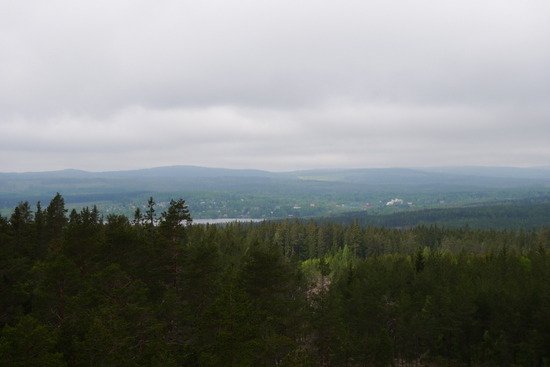
View of Bergslagen


3. Björkberg
East of Olovssjön the trail passes over majestic heights and then down the slope, giving limited views of the region around Ljusnaren. The fact that both the valleys and the higher areas have been used for agriculture is 
possible due to the impressive walls of stone in the forest along the path at Björkberget. 
On the ground that slopes down to Olovssjön, the trail passes several small mining holes. While these holes are said to have been test holes, they show the amount of work that was done to find ore deposits in this copper mountain district. 
A one-mile west of the highway, the trail passes right through Finn mine's copper mining area.


4. Finnshyttehedarna
After passing Garhytteån, a source of Arbogaån, the trail emerges into a heath 
of pine. Ridges dominate the area north of the highway towards Skäret, while the area to the south is dominated by shifting sand dunes. Ice rivers and the melting of inland ice created the streams and the ”dead ice” craters. The sand dunes were created later, but before vegetation could grow in the cold, windy tundra climate.
In the woods on top of Birch Hill, the trail follows a mighty stone wall.

5. Djäkens bygge
The trail makes its way down to the lake Ljusnarn to the community swimming area, Djäkens bygge. There is a parking area and, during the summer, access to toilets.
Rest area at Olovsjön.

6. Ljusnarsbergen
South of Djäkens bygge, the trail follows Ljusnarn to the stage’s finish at Stjärnfors. Of the many fine lake views, the best is experienced from Ljusnarsbergen, 2 km south of Djäkens bygge. On the other side of the 
lake, Nittälven flows, known for its backwoods character and for being one of the county’s most exciting canoe routes.
The trail reaches the lake Ljusnarn at the municipal swimming Djäkens construction.


7. Stjärnfors
As the Rällsälven flows out of the Ljusnarn, the presence of ore and the possibility of hydropower created a natural center for regional industry.
Unlike the other industrial communities in Kopparberg’s mountain district, the focus here was not on copper, but on the rich occurrences of iron ore.
The privilege of starting an iron forge was given to Stjärnfors in 1676. Stjärnfors later grew to be a center for the refinement of iron from the smelt houses of the area, even using Bessemer converters. 
Production was ended in 1905, but the flowing water is still used by a power station, which means that the dams and canals have been preserved. The Stjärnfors Manor has also been kept, whereas the surrounding fields are primarily used as a golf course.
The trail then alternately up and down, sometimes in spruce and occasionally in the pine forest.

View of Ljusnarn.


Overview map:


Accommodation and service phase 2
transport
From Örebro takes you by bus or train to Kopparberg. From here you can take taxi to Gillersklack or go on trail 2 km from the Kopparberg station.

http://www.tagkompaniet.se

http://www.bangbro.se/se


Windbreaks
There are two shelters along the trail, at Olovsjön and Stjärnsfors. There is also a toilet and fireplace.
  
water
At Gillersklack or Kopparberg.
  
Food
In Kopparberg center you will find both supermarkets and restaurants.


HIKINGTIPS: KONTAKT

For more detailed information see contact below.


BERGSLAGEN ETAPP 1-7

 
Kopparbergs turistbyrå - 0580-805 55,turism@ljusnarsberg.se

Nora turistbyrå — 0587-811 20, info@nora.se
Lindesbergs turistbyrå — 0581-811 70,turistinfo@lindesberg.se


KILSBERGEN ETAPP 8-13

  
Örebrokompaniet — 019-21 21 21, info@orebrokompaniet.se

Kilsbergen konferens & lodge — 019-29 55 00, info@kilsbergen.se


TIVEDEN ETAPP 14-17

 
Laxå turistbyrå - 0584-109 20, turistbyra@laxa.se

Askersunds turistbyrå - 0583-810 88, turistbyran@askersund.se
Tivedstorp - 0584-47 20 90, info@tivedstorp.se


ANSVARIG PÅ REGIONFÖRBUNDET 

 
Kjell-Ove Nordström, 019-602 63 41

Du kan även mejla oss på: 
naturochfriluftsliv@regionorebro.se


Kloten - Gillersklack 21 Km

SWEDEN: Bergslagsleden Stage 1
Kloten - Gillersklack 21 Km
Kloten
The Bergslag Trail (Bergslagsleden) begins in Kloten, on county road 233 between Malingsbo and Kopparberg. 
Lodging is available in the village of Kloten - for information call +46 580 883 00. Cabins are selfcatered. Swimming and short-stay camping areas can be found along the Stora Kloten lake. Reception and kiosk. There are no bus connections in Kloten.
East of this area is a marked connection to Bruks Trail (Bruksleden) in Västmanland, beginning in Malingsbo. For information on Bruks Trail, 
http://www.bruksleden.se
The walk starts in the old skogsarbetarbyn Kloten, a village which today consists of only a few resident household.


Gillersklack
This stage finishes at Gillersklack, about 6 km north of Kopparberg. Follow signs from highway 60. Camping available. Other Gillersklack accommodations include cabins, a hostel, food, coffee and swimming. Information: Tel. +46 580-125 00 or the tourist office in Kopparberg, tel. +46 580-805 55, http://www.ljusnarsberg.se

Rest Area Lilla Kroktjärn
A rest area with shelter, fire ring, and dry toilet is found next to Lilla Kroktjärnen, 11 km from Kloten. Drinking water not available, but boiled lake water can be used for cooking. A simpler rest area also exists, found near Sand Stream (Sandån) - near point 4, 7 km from Kloten.
It is of great help to the management if you take 
your rubbish with you when you leave the rest areas.
The first part of the trail runs along an old drive. Here are some well-preserved paving stones at the edge of the road down to the lake Långvattnet.


1. Kloten
Kloten has a long, shifting history, starting several hundred years ago as a small village near the waterfall between the lakes Stora Kloten and Långvattnet. The village grew into a booming industrial community and 
even had its own railroad that ran about 20 km down to Bånghammar.
In the early 1900s, logging replaced iron working as the main industry in the district. 
Kloten was a housing community and center for forestry in the region. The downsizing of the timber industry during the past century has reduced the population of Kloten and the town has lost its forestry-related importance.
The Bergslag Trail starts in the center of Kloten and passes the old smelt house 
that was rebuilt to be a fish hatchery. Other buildings to see include the large white station house, the engine sheds, as well as the former forester’s yellow house.
After 7 km you will reach a trail sinker party at the small Sandån.


2. Trollberget
A kilometer after the start in Kloten is a 300 m long looping trail that goes up to Trollberget. At the top there is a rest area with table and benches.
Footbridges across one of the marshes to pass on their migration.


3. Källtjärn
About 5 km west of Kloten, the trail passes through Källtjärn and its overgrown meadows and fi elds. The village was once so populated that it even had a school. The heavy work of the iron industry required, as with the timber industry before its downsizing, many people and horses out in the forest. Crofts 
and small villages therefore appeared in order to provide for people and animals. Many of these crofts can be dated back to the Finnish colonization of Sweden in the 1600s.

4. Hill cabin by Sandån
Several kilometers west of Källtjärn is Sandån, one of the Arbogaån source streams. Just before the trail passes the stream is a reconstructed backstuga (hill cabin) called Åbostugan that is partially built into the slope of the hill. The very poor lived in such dwellings, not able to afford land with fields.


Sometimes the residents of these cabins had a cow or a few goats that grazed in the forest and survived on swamp grasses over the winter.
A beautiful landscape opens up just before you arrive at the restored croft at Sandån.


Åbostugan is very nice by the river. Here you can rest or stay overnight.Outsite the cottage's fireplace and wood storage 


5. Dragtjärn area
West of Sandån, the trail passes through a hilly area with large rocks and many tiny lakes. Inland ice fl owing through here left behind an irregular moraine, called the “Dead Ice Moraine,” which was created when isolated masses of ice slowly melted during the Ice Age. Here, the trail goes through the Getryggen nature reserve. Before the foresting of later years the area had strong wilderness characteristics. There is still a smaller region that displays these wild features. 

6. Småtjärnarna 
 (The small lakes)
Three kilometers west of the rest area, the trail comes into an entire system of small lakes. Islands can be seen in the lakes, created when the area was dammed in order to channel water to be used by a mill downstream.
The importance of waterpower in Bergslagen has been great - even the smallest of streams were often used. Nearly all of the lakes, big and small, have been used as water sources and basins.


7. Gillersklack
West of Holmsjön, the trail becomes steep, leading up to a plateau that hovers over the 350-meter mark. Gillersklack’s highest point is 407 m above sea level. A looping trail goes near the highest point. Gillersklack and its surrounding plateau area have more snow and longer winters than any other area in the county. Gillersklack is traditionally known as a winter sport region, with well-developed facilities for skiing and related sports.

Overview map:


Important to know
● Make fires only where designated fire rings/circles are present.

● Make sure that your fire is completely out before you continue hiking.

● Refrain from starting fires during the dry periods of summer when risk of forest fire is high.

● Do not break off limbs or branches from living trees.

● You may pitch tents along the trail, but preferably near the rest areas and 
not more that one night in the same place.

● Do not stray from the trail when near built-up areas, cultivated fields or planted forests.

● Do not litter.

● If hiking with a dog, be aware that you must always have the dog on a lead/leash in the forests/fields during the period from March 1 - August 20.

● So as to avoid conflicting with moose hunting season, you shouldn’t use the    trail during the most intensive hunting period - the second week in October and several weeks forward.


Facts about the Bergslag Trail 
(Bergslagsleden)
The Bergslag Trail is a 280 km hiking trail 
passing through the entire county of Örebro. It is divided into 17 stages. The agency responsible for the trail is Regionförbundet Örebro. The Bergslag Trail is identified by orange markings on trees or on posts. At 
road crossings or when the trail branches, directional arrows with the Bergslag Trail symbol appear. The Bergslag Trail forms part of European walking route E1, which extends from southern Italy to the Swedish 
mountains. www.stfturist.se


Bus Connections
There is no regular bus traffic to Kloten. 
Information on bus schedules: +46 771-22 40 00 Suggested reading (Swedish)
Esbjörnsson, Estrid, Värt att se i Örebro Län; Lindstén Carl Anders, Sevärt i Södra Kilsbergen; Hellström, Lena, Utsikt från Bergslagsleden.


For further information
Kopparberg Tourist Office: +46 580-805 55, 
http://www.ljusnarsberg.se; Örebro County Regional 

Development Council, +46 (0)19-602 63 00, 

Home page for outdoor life
At http://www.regionorebro.se you can find a collection of information on nature and outdoor life in the Örebro region. It contains 
current information on places to stay along 
the Bergslag Trail. You can download pages 
on trail stages and get suggestions for other 
activities. The home page also has information on fishing opportunities, canoe rentals 
and links to activity organisers.


HikingTIPS: KONTAKT

For more detailed information see contact below.


BERGSLAGEN ETAPP 1-7

 
Kopparbergs turistbyrå - 0580-805 55,turism@ljusnarsberg.se

Nora turistbyrå — 0587-811 20, info@nora.se
Lindesbergs turistbyrå — 0581-811 70,turistinfo@lindesberg.se


KILSBERGEN ETAPP 8-13

 
Örebrokompaniet — 019-21 21 21, info@orebrokompaniet.se

Kilsbergen konferens & lodge — 019-29 55 00, info@kilsbergen.se


TIVEDEN ETAPP 14-17


Laxå turistbyrå - 0584-109 20, turistbyra@laxa.se

Askersunds turistbyrå - 0583-810 88, turistbyran@askersund.se
Tivedstorp - 0584-47 20 90, info@tivedstorp.se


ANSVARIG PÅ REGIONFÖRBUNDET 


Kjell-Ove Nordström, 019-602 63 41

Du kan även mejla oss på: 
naturochfriluftsliv@regionorebro.se

Bergslagsleden - The Bergslag Trail


SWEDEN: Bergslagsleden - The Bergslag Trail

Bergslagsleden (The Bergslag Trail)  is one of Swedens top-three trails for hiking in Sweden.
There are 17 stages to choose from along Bergslagsleden (The Bergslag Trail) all of which are designed so as to be able to be completed during one day of hiking in Sweden, though levels of difficulty vary.
Bergslagsleden is marked with orange rings painted on trees or poles. Signs are present when the trail branches or crosses a road. The trail stretches from Kloten in the north to Stenkällegården in the south, a total length of 280 km. Roughly half-way through each stage there is a wind shelter with fire ring and dry toilet.
At some of the rest areas, at Bergslagsleden trash receptacles have been removed, especially in cases where it is too far for the management to transport the garbage. Additionally, rubbish management is quite costly these days. We therefore ask you to “leave no trace" and take all of your garbage with you when leaving a rest area. Trail descriptions and maps are available for every stage. Regionförbundet Örebro is responsible for the trail.
Bergslagsleden is maintained by non-profit organizations that manage trail markings, rest areas, etc. Bergslagsleden welcomes you! Relax, appreciate the silence and enjoy!
Great efforts have been made so that the Bergslag Trail can offer reasonable lodging alternatives, from wind shelters to lodging at nearby recreation centers. Lodging alternatives are available in one form or another in nearly every stage. The length of each stage is shown in the table below.
1 Kloten-Gillersklack 21 km                       
2 Gillersklack - Stjärnfors    17 km                      
3 Stjärnfors - Nyberget 23 km                      
4 Nyberget - Uskavi 23 km                      
5 Uskavi - Hammarby 17 km                      
6 Hammarby - Digerberget 14 km                      
7 Digerberget - Mogetorp 16 km                      
8 Mogetorp - Blankhult 16 km                      
9 Blankhult - Ånnaboda 10 km                      
10 Ånnaboda - Suttarboda 7 km                      
11 Suttarboda - Leken    15 km                      
12 Leken - Sixtorp    20 km                      
13 Sixtorp - Svartå herrgård    19 km                      
14 Svartå herrgård - Ramundeboda   19 km                      
15 Ramundeboda - Gråmon    23 km                      
16 Gråmon - Tivedstorp    14 km                      
17 Tivedstorp - Stenkällegården    12 km

Edible Flower Recipes


Edible Flower Recipes

Bloomsbury Salad

Select some young tender lettuce leaves, then wash and dry them before tearing into a wooden or glass bowl. Add several whole monarda leaves and a similar quantity of nasturtium leaves, and toss in an oil and vinegar dressing. Gather the fresh flowers of borage, viola, nasturtium, rose, calendula, and monarda flower heads. Lightly pull apart the calendula, monarda, nasturtium and viola, but leave the borage flowers whole, then mix them all gently into the salad. Garnish the top of the salad with a few whole nasturtium flowers and rose petals.

Calendula Scones

  • • For 8 scones:
  • • 450g (1lb) plain flour
  • • 1 tsp salt
  • • 1 tsp bicarbonate of soda
  • • 45g (1½ oz) butter
  • • 300ml (½ pt) milk with 2 tsp of cream tartar.
  • • 2 tbsp fresh calendula petals.

Preheat oven to 220°C (425°F) Gas mark 7. Sift the flour into a bowl with the salt and bicarbonate of soda. Rub in the butter and add the milk and the cream of tartar and the calendula petals. Mix thoroughly until a soft dough is formed. Turn onto a floured board, knead lightly, and then roll to about 2cm (¾in) thick. Use a 5cm (2in) plain cutter to cut out the scones and put them on a lightly floured baking sheet. Bake in the oven for 12-15 minutes until risen and golden brown. Cool on a baking tray before eating.

Citrus Blossom Special Salad

  • •¼ cup lemon juice
  • • ½ cup orange juice
  • • 3 tbsp honey
  • • 2 tbsp lemon rind, finely grated
  • • 2 tbsp ginger, finely grated
  • • ½ tsp cayenne pepper
  • • 4 cups carrots, finely grated
  • • ½ cup almonds, thinly sliced
  • • 1 cup golden raisins
  • • ½ cup calendula petals
  • • ¼ cup citrus petals
  • • 15 to 20 nasturtium leaves

Whisk together juices and honey. Mix in lemon rind, ginger and cayenne pepper. Add carrots, almonds and raisins. Just before serving, toss in calendula petals and citrus petals. Serve on a bed of nasturtium leaves.

Citrus Dip for Begonia Blossoms

  • • 1 tbsp honey
  • • 1 tbsp frozen orange juice concentrate
  • • 1 tsp orange zest
  • • ½ tsp lemon zest
  • • ½ cup low fat yogurt
  • • 4 large tuberous begonia flowers.

In a small bowl, combine the honey, orange juice concentrate and orange and lemon zests. Add the yogurt and mix well. Pour the yogurt mixture into a small decorative bowl, cover with cling film and refrigerate until ready to serve. Just before serving, gently wash the begonia blossoms and remove each of the petals at its base. Place the bowl of flavoured yogurt on a large platter and arrange the petals in a decorative pattern around the bowl. Serve as a delicious appetiser within the hour to prevent the petals wilting, Serves 4-6.

Cottage Cheese Dip

  • • 1 cup cottage cheese
  • • 1 clove garlic, crushed
  • • ¼ tsp. caraway seeds
  • • ¼ cup yoghurt
  • • ½ cup mixed flower petals torn into small pieces
  • • Salt

Force the cottage cheese through a sieve. Add remaining ingredients. Chill for 2 hours and garnish with borage flowers. Makes 1½ cups.

Courgette Flower Fritters

  • • 125g (4oz) plain flour
  • • Pinch of salt
  • • 1 large egg
  • • 300ml (10fl oz) semi-skimmed milk
  • • Sunflower oil for deep frying
  • • Icing sugar for serving

Beat all the ingredients together in a bowl for a smooth, lump-free batter. When the frying oil has almost reached the correct temperature of 188°C (370°F), dip the courgette flower in the batter and allow any drips to fall back into the bowl. Drop the flower into the hot oil and remove after 1 minute or so when the fritter will be a pale golden colour. Drain on paper towels and serve dusted with icing sugar. The same process can be used to make fritters of other types of edible flower as well.

Crystallised Flowers for Decoration

  • • Use freshly picked primroses, pansies, violets, pinks, roses or other recommended small flowers.
  • • Caster sugar
  • • The white of an egg

Pick the flowers when the dew has dried and select only undamaged, perfectly formed flowers. Gently whisk the egg white until it is bubbly, but not frothy. Paint the white onto all parts of the flower, then dip it into the caster sugar, making sure that it is completely covered. Shake off any surplus and leave on greaseproof paper in a warm room to dry. Use when hardened. When thoroughly dry, place in an airtight container, layered with greaseproof paper and store in a cool place. They will keep for about a week.

Fried Golden Needles

  • • 12 hemerocallis (Daylily) flowers
  • • 1 egg beaten with 1tsp of water
  • • 1 cup of all purpose flour
  • • Vegetable oil

Dip each flower in the beaten egg. Roll them each in flour. Sauté the coated flowers in hot oil until crispy.

Hibiscus Tea

  • • 1 tbsp of fresh hibiscus petals
  • • 1 cup boiling water
  • • Honey (optional)

Steep petals in water in a cup for 5 minutes, for additional sweetness add honey if desired.

Hollyhock & Nectarine Salad

  • • 2 nectarines with either white or yellow flesh
  • • 2 hollyhock flowers
  • • 2 sprigs of mint (in flower if possible)

Cut the nectarines in half, remove the stones (pips) and slice the fruit. Arrange the slices on individual serving plates. Remove the stigma from the centre of the hollyhocks, and then cut off the green parts. Brush any excess pollen off the petals. Arrange the petals around the nectarine slices and garnish with sprigs of mint.

Home Fries with Chive Blossoms

  • • ¼ cup (59ml) extra-virgin olive oil
  • • 4 cups (944ml) boiled or steamed potatoes, sliced
  • • Salt and freshly ground black pepper
  • • 8 chive blossoms, florets snipped off and separated

Heat the oil in a frying pan. Add the potato slices; cook until the undersides begin to brown. Using a large spatula, turn the potatoes; sprinkle with salt and pepper to taste. Sprinkle with chive florets. Continue cooking until the potato slices are browned on both sides and serve immediately.

Marigold Butter

  • • Petals of 20 French marigolds or tagetes
  • • 225g (½ lb) butter, softened to room temperature

Finely chop the petals. Mix them into the softened butter and leave to sit in a cool room for several hours. Roll into a log shape using greaseproof paper and place in the fridge overnight. This will keep in the fridge for up to 2 weeks. Cut slices and garnish any grilled fish or serve on toast or muffins.

Nasturtium & Runner Bean Omelette

  • • 50g (2oz) young tender runner beans
  • • 2 eggs
  • • 30ml (2tbsp) milk
  • • 2 nasturtium seeds
  • • 4 nasturtium petals
  • • Salt and freshly ground pepper
  • • 15ml (1tbsp) butter
  • • Freshly grated parmesan cheese
  • to taste.

Slice the runner beans finely and add to a saucepan of boiling water and cook for 4 minutes, then drain. Beat the eggs with the milk. Crush the seeds with a fork, and then add the seeds, leaves and petals to the egg mixture. Season lightly with salt and some freshly ground black pepper. Melt the butter in a frying pan over a gentle heat. Pour the egg and nasturtium mixture into the pan, add the beans and cook gently until the omelette has just set. Sprinkle with parmesan cheese and serve immediately, garnished with extra petals.

Pink Marmalade

  • • 1 cup granulated sugar
  • • 1 cup water
  • • 2 cups dianthus petals
  • coarsely chopped

Put sugar and water into a non aluminium saucepan. Bring to a boil and simmer until it thickens to a syrup consistency. Add the chopped dianthus petals and gently simmer, stirring frequently until pulpy. Pour into sterilised jars and allow to cool to room temperature. Once cool, place in the fridge and eat within 3 weeks.

Primrose Salad

  • • 1 round lettuce
  • • 115g (4oz) lambs lettuce
  • • 2 tbsp young primrose leaves, finely chopped
  • • 50g (2oz) parsley, chopped
  • • 450g (1lb) tomatoes, skinned and chopped
  • • ½ cucumber, peeled and chopped
  • • 15-20 primrose flowers
  • • 3 tbsp sunflower or olive oil
  • • 1 tbsp primrose or white wine vinegar
  • • Freshly ground black pepper and salt.

Wash and shake lettuce dry, discarding the outer leaves. Add the lambs lettuce, tomatoes, parsley, primrose leaves and cucumber and mix thoroughly. To make the salad dressing, combine the oil and vinegar in a bowl, whisk thoroughly, season with pepper and salt. Pour the dressing over the salad just before serving, toss and scatter the primrose flowers on top.

Rose Petal Sorbet

  • • 115g (4oz) caster (superfine) sugar
  • • 300ml (½pt) boiling water
  • • Petals of 3 large scented red or pink roses, with the white ends of the petals removed
  • • Juice of 2 lemons
  • • 300ml (½pt) rosé wine

Place the sugar in a bowl and add boiling water. Stir until the sugar has completely dissolved. Add the rose petals and leave to completely cool. Blend the mixture in a food processor then strain through a sieve. Add the lemon juice and wine and pour into a freezer container. Freeze for several hours until the mixture has frozen around the edges. Turn the sorbet into a mixing bowl and whisk until smooth. Re-freeze until frozen around the edges. Repeat the whisking and freezing process once or twice more, until the sorbet is pale and smooth, then freeze till firm. Serve decorated with a few crystallised roses or rose petals.

Rosemary Chicken

  • • 450g (1lb) skinless, boneless chicken breasts
  • • 3 tbsp sweet (unsalted) butter
  • • 2 tbsp rosemary flowers, coarsely chopped
  • • Juice of 1 lemon

Place chicken breasts in a polythene bag and hit with a rolling pin until 6mm (¼in) in thickness. Melt the butter in a pan and add chicken. Add rosemary flowers, then quickly sauté each side until golden brown. Sprinkle with lemon juice, then serve the chicken drizzled with the pan juices.

Strawberry Jelly and Fuchsia Flowers

  • • 675g (1½lb) fresh strawberries
  • • 125g (5oz) caster sugar
  • • 400ml (14floz) water
  • • 3 tbsp gelatine
  • • 6 fuchsia flowers, with stamen, pistils, and green parts removed
  • • 12-14 whole strawberries
  • for decoration.

Put the fruit, sugar and water into a saucepan and bring to the boil; simmer for 3 minutes as you stir. Push the fruit and liquid through a fine mesh sieve to remove all the pips. Return to the saucepan, heat to just below boiling and sprinkle the gelatine over the surface. Whisk until dissolved completely. Stir in the fuchsia flowers and pour into a 1.25lt (2¼ pt) metal jelly ring mould. Allow to cool and then chill for several hours until firmly set. Turn out onto a plate and fill the centre with strawberries and a few more prepared fuchsia flowers.

Sunflower Buds

  • • 8 sunflower buds
  • • 30g (1oz) butter, melted
  • • Sunflower petals for garnish

Bring a large pan of water to the boil. Put in the sunflower buds and blanch for 2 minutes, this will kill any bugs and remove any bitterness. Strain them into a colander. Refill the pan with water and bring to the boil. Add the sunflower buds and simmer for a further 3 minutes until tender, drain and toss in melted butter. Serve garnished with sunflower petals.

Violet Soup

  • • 1 litre (1¾ pint) of stock
  • • 40g (1¾ oz) long grain rice
  • • 1 teaspoonful lemon juice
  • • ¾ cupful of freshly picked, unwashed violets or small flowered pansies or violas.

Boil the rice in the stock for twenty minutes or until soft, add the violets and lemon juice, cover with a saucepan lid and simmer very gently for 2 minutes. Serve immediately.